

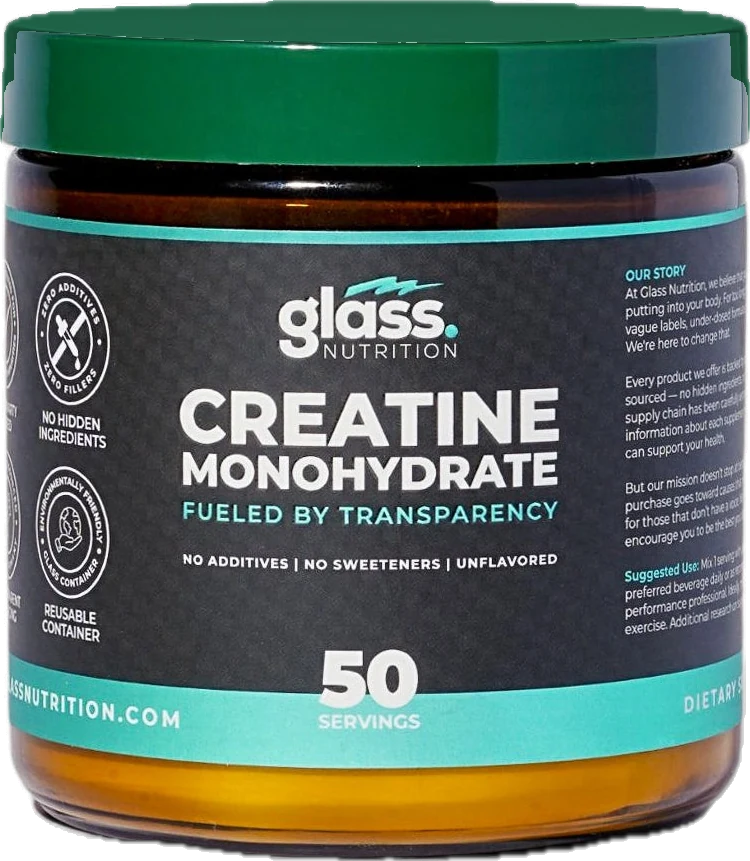
Creatine Monohydrate
Finished, bottled product. December 2025 report.
View the report for Creatine Monohydrate (opens in a new tab)Help center
Answers about our supplements, lab testing, orders and subscriptions.
No questions match. Email us at support@glassnutrition.com and we'll help.
Each product is tested 3 times: once at the raw material location, once at the manufacturing facility, and another time as a finished product by an independent lab.
The latest independent lab reports are in Lab results below.
We were thrilled with our 3rd party testing results. Our Creatine Monohydrate came back with no heavy metals detected, and we were well below all other thresholds.
Our Creatine HCl also had extremely low levels of heavy metals and no detectable Dicyandiamide.
Creatine Monohydrate: 1 scoop (5 g) per serving, 50 servings per jar. Ingredients: Creatine monohydrate. Nothing else.
Creatine HCl: 1 scoop (750 mg) per serving, 80 servings per jar. Ingredients: Creatine hydrochloride. Nothing else.
Use our dosing calculator to find your daily amount.
Creatine is effective whenever you take it. Taking it with a meal that includes carbohydrate, or carbohydrate and protein, has been reported to help your body retain more creatine, although that has not been shown to improve performance. Consistency is more important than exact timing.
No, but it is faster. Loading (about 20 g a day, split into four 5 g doses, for 5 to 7 days) is the quickest way to fill your muscles' creatine stores. A smaller daily dose, such as 3 g a day, fills them more gradually over about 3 to 4 weeks, so benefits may take longer to show. This applies to Creatine Monohydrate.
Creatine is naturally found in animal-based foods, especially red meat and fish. For reference, 1 lb of uncooked beef contains about 1 to 2 grams of creatine. While diet contributes, a typical diet leaves muscle creatine stores only about 60 to 80% full, and supplementation can raise muscle creatine by 20 to 40%.
Not beyond what you normally drink. Creatine can increase the amount of water your body holds (Powers 2003), mostly during a high-dose “loading” phase of about 20 g a day for 5 to 7 days (Antonio 2021). Controlled studies have not found that it causes dehydration or muscle cramps (Antonio 2021; Longobardi 2025).
The only extra water you need is what you mix it with. How much is up to you, but more water dissolves it more easily. In water at about 77°F (25°C), a 5 g serving of creatine monohydrate fully dissolves in about 10 oz (290 mL), and in an 8 oz glass about 80% of it dissolves (Gufford 2010). Cold water dissolves less (Jäger 2011).
Sources
Creatine monohydrate is one of the most researched supplements in history. Studies show that long-term use in healthy adults is safe when taken at recommended doses. Always stay hydrated, as creatine can increase water retention in muscles.
Creatine primarily supports muscle strength, power, and recovery. It may cause a small increase in water weight in muscles but does not directly increase fat. Gains in muscle can indirectly support metabolism over time.
Absolutely. Because creatine is mostly found in meat and fish, vegetarians and vegans often have lower baseline levels and may see even greater performance benefits from supplementation.
Glass doesn't react with what's inside it, and moisture and air can't get through it (Pagnotta 2026). Plastic is different: studies have found that chemicals can move from plastic packaging into food (Gerassimidou 2023), and plastic containers can release tiny bits of plastic into what they hold (Hussain 2023).
We believe you deserve the highest quality for your body.
Sources
Yes. When the jar is empty, you can wash it and use it again.
Email us at support@glassnutrition.com within 7 days of delivery with your order number and a photo of the damage, including both the inside and outside of the packaging. We'll send a free replacement, and there's no need to return the damaged item.
Please take your photos first, then throw away any broken glass carefully.
Orders typically ship within 1 business day (Monday to Friday, excluding holidays). You'll get a confirmation email when you place your order and a second email with tracking once it ships.
Orders over $100 ship free in the United States. Subscriptions of 3 jars every 150 days also ship free in the United States.
We ship to Canada via USPS, UPS and FedEx. Shipping costs for Canada are shown at checkout.
Subscribe & Save is available on Creatine Monohydrate. Choose a delivery every 25, 28, 30, 35, 40, 45, 50 or 60 days at 10% off the regular price, or 3 jars every 150 days at 15% off with free shipping in the United States.
Your subscription renews automatically until you cancel. There's no minimum number of orders.
Go to glassnutrition.com/apps/subscriptions and log in with the email you used at checkout, or use the Manage Subscription button in your subscription emails. You can also email support@glassnutrition.com.
To avoid your next charge, cancel before your next billing date, which is shown on your subscription page.
Every Glass Nutrition subscription includes VIP Status. While you’re subscribed, you get add-ons for free when they come out.
Try any Glass Nutrition product for the first time risk-free. If you're not satisfied, contact us within 7 days of delivery and we'll refund the purchase price, even if the jar is opened.
The guarantee applies once per customer, per product, on your first purchase of that product. For subscriptions, it covers your first subscription order only.
Yes. Unopened products with the original seal intact can be returned within 30 days of delivery for a full refund of the product price. Email support@glassnutrition.com with your order number first, and we'll reply with a prepaid return label.
Approved refunds are processed within 5 business days and returned to your original payment method. Your bank or card issuer may take another 5 to 10 business days to show it on your statement.
Certificates of analysis
Every product is tested 3 times. Here are the independent lab reports for the finished product.
Finished, bottled product. December 2025 report.
View the report for Creatine Monohydrate (opens in a new tab)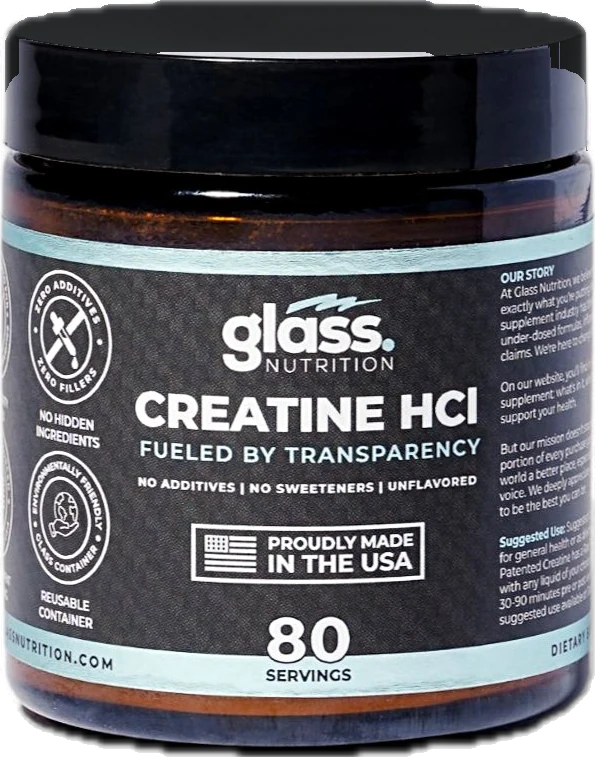
Finished, bottled product. December 2025 report.
View the report for Creatine HCl (opens in a new tab)Email us any time. We'll usually reply within 1-5 hours during weekdays, excluding holidays. Please allow up to 48 hours.